

CHAINALIGN
From Goldratt to GPUs: Automating Theory of Constraints for the AI Era
How real-time, probabilistic constraint intelligence replaces quarterly bottleneck reviews
Pramod Prasanth • December 2025 • 10 min read
Key Takeaways
- 160% of process improvement projects fail because teams target local issues, not the true system-wide bottleneck
- 2TOC 2.0 replaces quarterly spreadsheet reviews with real-time, 5-minute constraint recalculation
- 3100M+ GPU simulations reveal the probabilistic nature of bottlenecks—they shift constantly
- 4The Socratic Inquiry Engine captures human reasoning to continuously improve recommendations
Abstract
Goldratt taught us: throughput is limited by a single constraint.
Yet most companies still identify bottlenecks manually, in spreadsheets, long after the fact. Up to 60% of process improvement projects fail, often because teams target local issues rather than the true system-wide bottlenecks.[1]
TOC 2.0 brings:
- •Real-time constraint detection
- •Probabilistic simulation
- •Causal reasoning
- •Automated, explainable recommendations
The result: You stop optimizing the wrong things and start fixing the real constraint in minutes, not months.
Section 1
The Stagnation of Optimization
1.1 Data Everywhere, Direction Nowhere
- •ERPs and MES systems collect data.
- •They do not explain why throughput is dropping.
- •Operations teams guess, debate, and fire-fight.
Insight: Data ≠ Direction
1.2 Optimizing the Wrong Things
Most companies:
- •Improve non-bottleneck equipment
- •Celebrate OEE gains that don't increase throughput
- •Launch improvement projects that cancel each other out
A distribution center boosted picking station efficiency yet saw throughput stuck at 550/700 cartons/hour because the upstream conveyor transfers—not assembly—were the true constraint.
— Bastian Solutions TOC Case Study
Impact: Local wins. Global losses.
1.3 Bottleneck Analysis is Still a Spreadsheet
Today's approach is:
Reality: The bottleneck moves.
Sometimes weekly. Sometimes hourly.
Section 2
Theory of Constraints 2.0
2.1 Continuous Instead of Quarterly
TOC 2.0 replaces periodic reviews with:
- •Automatic recalculation every 5 minutes
- •Live data from ERP/MES
- •Updated constraint map in real time
Result: No more "old bottleneck charts."
2.2 Probabilistic Instead of Fixed
Old TOC assumes everything is stable. TOC 2.0 treats everything as variable:
HOW:
100M+ GPU simulations → probability of each resource becoming the bottleneck.
The Illusion of the "Fixed" Bottleneck
Outcome: You see the true constraint under uncertainty.
2.3 Proactive Instead of Reactive
Instead of waiting for a bottleneck to appear, the system predicts:
"Throughput dip likely in 72 hours"
"Labor shortfall will shift constraint to Packaging"
"Supplier risk will block Assembly next week"
Operations moves from firefighting → pre-empting.
Section 3
The Technical Breakthrough: Causal AI
3.1 Why LLMs Alone Can't Do This
LLMs can't:
- ✗Understand system physics
- ✗Perform counterfactuals
- ✗Trace cause → effect
- ✗Avoid fabrication under uncertainty
LLMs predict the next word. Operations needs to predict the next bottleneck. These are fundamentally different problems.
Operations needs causality, not text prediction.
3.2 The TOC 2.0 Stack
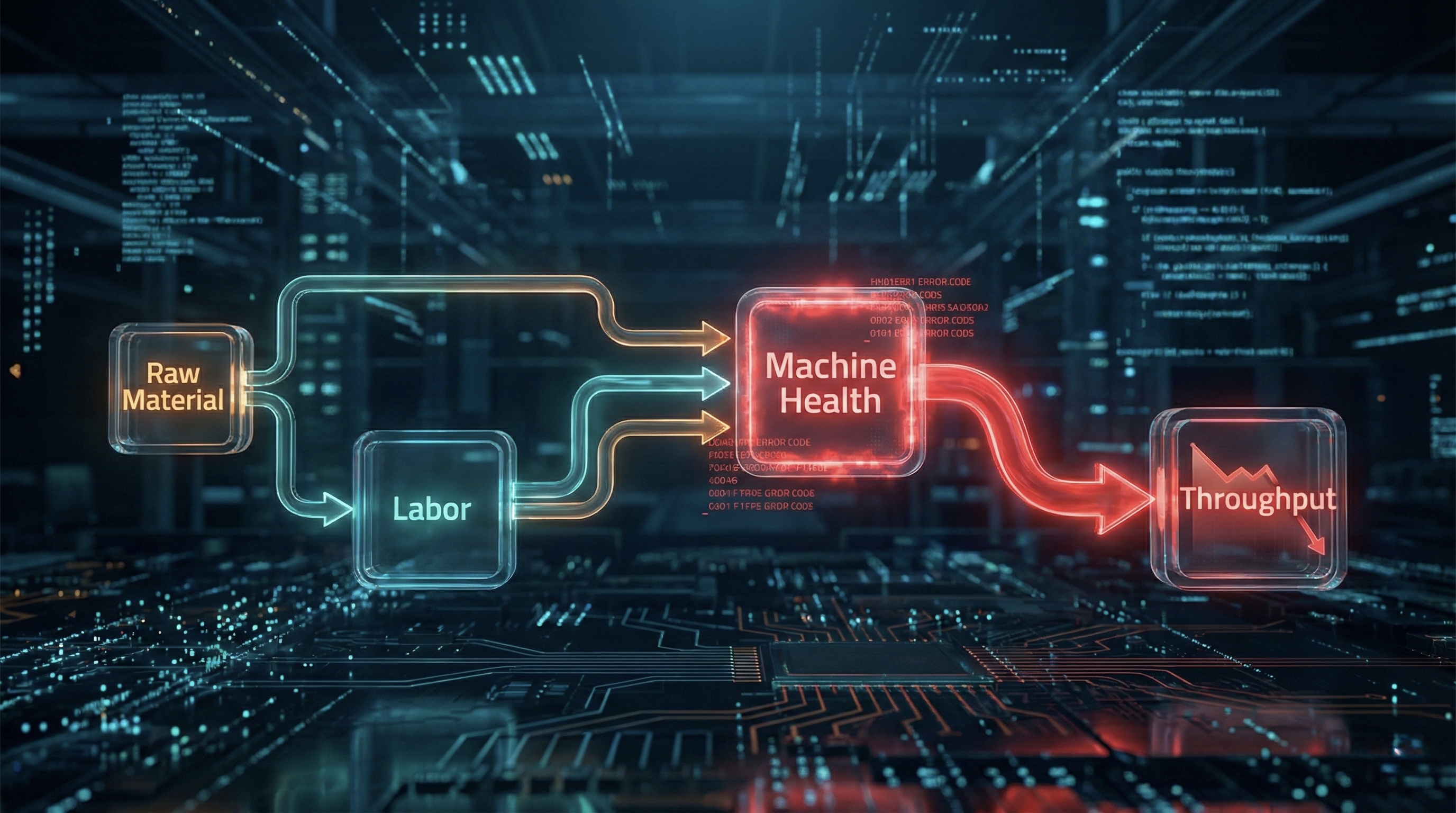
Causal Graphs (Bayesian Networks)
- • Map how demand, lead times, failures, and capacity influence each other
- • Reveal what caused the bottleneck
Constraint Programming
- • Encode hard and soft limits
- • Validate plan feasibility
- • Quantify trade-offs ("Revenue at Risk," "Margin Hit")
GPU Simulation
- • Evaluate millions of potential futures
- • Rank constraints by probability and financial impact
> SYSTEM ALERT: Bottleneck detected at Mixing_Station_04.
> CAUSE: Material Yield Drop (Probability: 88%).
> IMPACT: $42,000 Revenue at Risk in next 8 hours.
> RECOMMENDATION: Re-route Order #902 to Line B. (Recover $38k).
Together: You get real-time, explainable constraint intelligence.
3.3 The Socratic Inquiry Engine

When humans override a recommendation:
- 1The system asks why
- 2Captures the reasoning
- 3Updates its causal understanding
- 4Improves future recommendations
Human judgment becomes training data.
Conclusion
The Shift Has Started
Decision Support is over.
Companies need Decision Operating Systems—platforms that:
- •Find the constraint
- •Predict when it will shift
- •Quantify impact automatically
- •Recommend the best action
- •Learn from every override
- •Store the reasoning as institutional memory
This is Goldratt's vision, rebuilt for the AI era—where the drum never stops beating because the system always knows where to find it.
Most companies still optimize the wrong parts of the system.
Stop optimizing the non-constraints.
Start automating constraint intelligence.
References
- ProcessModel. "Last Year 60% Of Process Improvement Projects Failed." processmodel.com
- Bastian Solutions. "Increase Operational Throughput Using the Theory of Constraints Principles." bastiansolutions.com
- The Powers Company. "When Upstream Material Flow Becomes the Bottleneck." thepowerscompany.com
- Goldratt, E. M. (1984). The Goal: A Process of Ongoing Improvement. North River Press.