
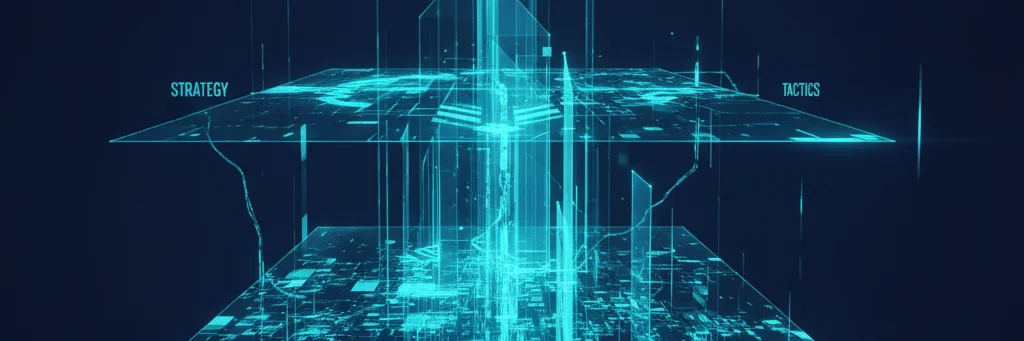
True strategic alignment requires operational integration, not mere communication.
If your strategy does not exist at the point of a micro-decision, you do not have a strategy. You have a wish list.
The Translation Gap
Strategy operates in market-share metrics. Operations focuses on production rates. Without real-time translation between these languages, structural misalignment is inevitable.
The executive team discusses portfolio positioning while the plant manager calculates changeover times. Both are optimizing. Neither is aligned.
The Latency Trap
Strategy moves slowly. Operations reacts instantly.
When floor teams make survival decisions without connection to strategic priorities, those choices often undermine stated goals. A production supervisor expediting an order to hit a delivery target may violate a margin priority set three levels up.
Neither is wrong. They are operating on different information at different speeds.
The Coherence Tax
Large organizations hemorrhage energy when departments optimize for conflicting objectives. Sales pushes volume. Finance pushes margin. Operations pushes efficiency. Each is right within their frame.
The costs are hidden across multiple budget lines: expedited shipping, quality rework, inventory carrying costs, customer churn. No single dashboard shows the coherence tax.
The Solution: Decision Systems
Rather than replacing human judgment, decision systems integrate expertise with data:
- Strategic guardrails embedded directly in execution tools so the constraint is visible at the point of choice
- Real-time signals when competing priorities conflict so trade-offs are explicit, not implicit
- Feedback mechanisms flowing operational reality back to strategy makers so plans adapt to ground truth
The distinction matters: the goal is steering through constraints, not comprehensive planning.
Alignment as Architecture
Alignment is a systems feature, not a cultural feeling.
Without architectural bridges connecting strategic intent to daily micro-decisions, organizations default to press releases rather than genuine strategy.
Culture cannot compensate for missing infrastructure.
Originally published on pramod.ch